|
July 2, 2008
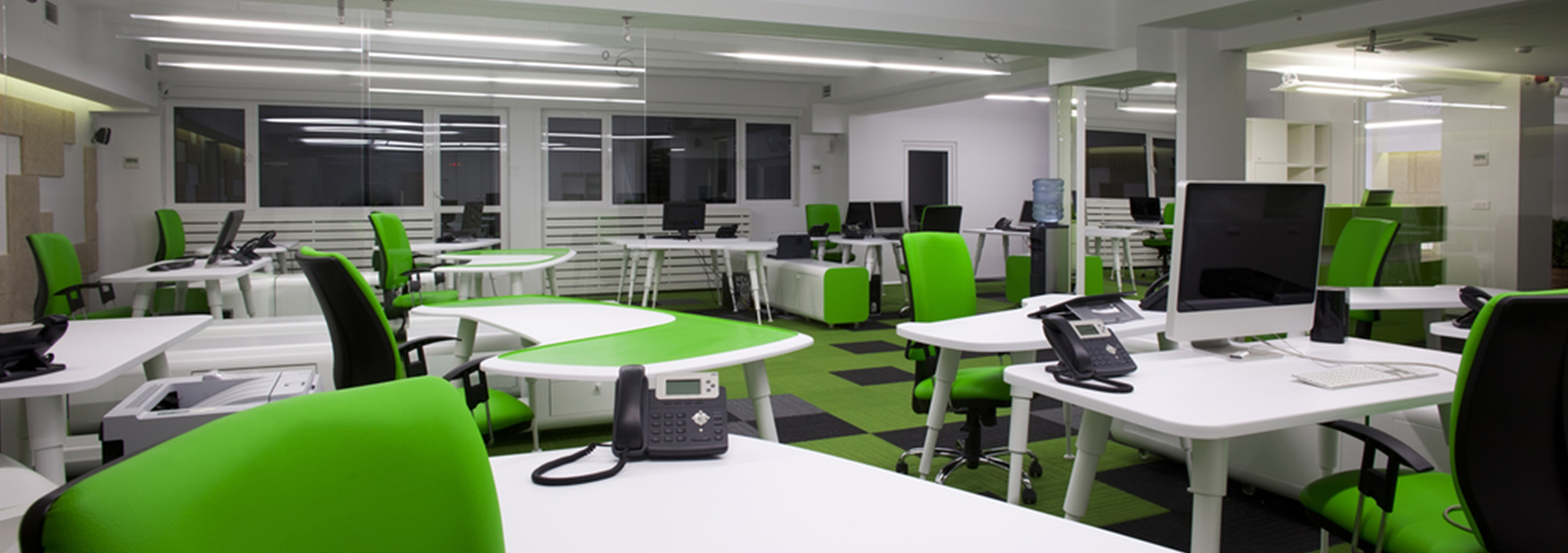
We are often asked what materials are best to use in a modern office for flooring. This is an area where you can introduce a bold colour or design, and even use different colours to indicate different zones, or fire routes. Traditional carpets on a roll are not really ideal, as they can be tricky to repair (wear and tear and coffee damage happens far quicker in an office environment than it would in a domestic one due to the increased traffic). However carpet tiles are a good solution as they allow the user to replace single tiles at a time. If the carpet is made with a thick pile, then it is often hard to see any joins and the finish is similar to that of a roll, but without the drawbacks. Carpet tiles can also be useful when used with a raised floor as they can allow easy access to the wiring below the floor, and are usually supplied at the same size as the raised floor grid tiles (600×600mm). For areas such as coffee points where a carpet could quickly become stained a vinyl floor-covering works well. You can get a realistic wood effect vinyl that is actually laid in strips (like wooden planks) which allows for access under the floor should it be needed, and has several advantages over traditional wood, or laminate flooring products. One of the key advantages here is that the vinyl is quiet when walked upon; this may not seem a big deal, but many offices that were refurbished in the late 1990s with laminate floors soon found that the constant sound of heels on the wooden floor became a real problem. Vinyl is also very hardwearing and water resistant and so is a good choice for offices looking for a modern appearance. There are even companies that produce vinyl floor tiles that look like steel flooring for an industrial effect, or you can even get tiles with holograms set within them for a futuristic feeling.
For advice on office interior design, give us a call and we can discuss how we can bring your space up to date.
June 13, 2008
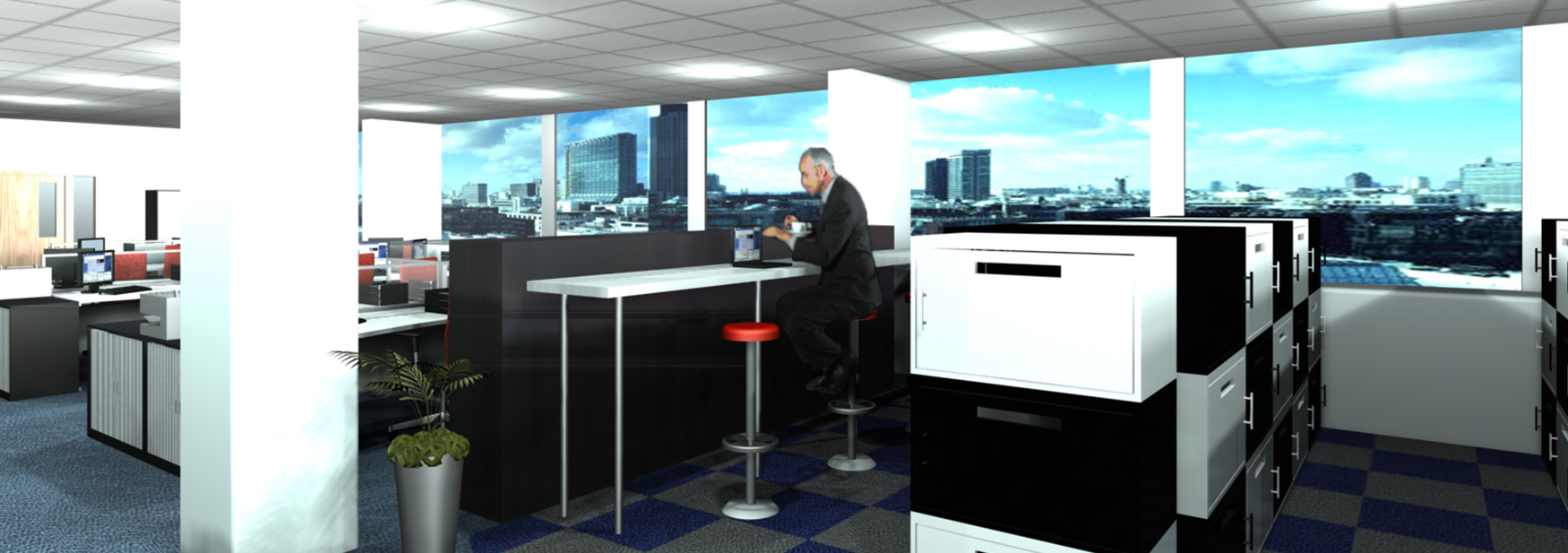
We are often asked how can we help to make offices a little less cold and sterile, and a great way to do this is to maximise your natural daylight resources. The colour, feeling and effects of natural daylight just can’t be replicated by artificial light, and yet so many offices have poor layouts that block daylight within the office. A key principal here is to ensure that windows are not blocked by storage cabinets; the simplest way to do this is by putting all storage cabinets against partition walls. Most offices though have more storage cabinets than wall space, so the best way to ensure that natural daylight is maximised is to only ever have cabinets lined up perpendicular (at 90 degrees) to any windows. This may seem obvious, but so many offices have a row of tall cabinets running through the centre of the office space, and so these are actually parallel to the windows. What this then means is that one half of the office gets good natural daylight in the morning, but very poor in the afternoon and the other side vice versa. Through keeping the cabinets at 90 degrees some light is obscured, but you avoid the dark and light extremes. Of course investing in better storage solutions would help further, particularly a system such as a rolling stack (as discussed in earlier blog posts), as this would allow you to keep your storage in one area and so keep the open areas open.
As well as re-organising your storage, you should also look at the positioning of desks. A common mistake is to put a single manager’s desk (which is often unoccupied) next to the windows, with the bulk of the staff deeper in to the office floor plate away from the natural light. By ensuring that the natural light resource is maximised to as many workstations as possible, the overall feeling of the space for the staff will be improved. There are occasions, such as with a very large floor plate, when this can’t be done, and so here you may need to look as specialised lighting solutions, such as daylight simulation bulbs for individual desk lamps, and using as many transparent or translucent materials as possible around the office, such as frosted glass screens on desks rather than heavy fabric ones.
If you would like us to redesign your office to maximise your natural daylight resources, give us a call.
June 5, 2008
The one thing that we see time and time again when surveying offices is that most companies claim to be lacking in storage, yet the actual cabinets are often half empty. Effective office storage systems are absolutely critical to an effective office design layout, and the process needs to begin with an assessment of what actually needs to be stored on site. These days there are many office storage companies that offer archiving services that can allow you to store paperwork away from your office, yet be able to retrieve it quickly for a small fee. This can allow you to remove cumbersome storage cabinets from your office space and then open up the space improving both natural light and air circulation. There will always be some things that need to be stored on site, but with effective scanning systems every piece of paperwork can be catalogued and stored on your company servers. Not only will this reduce the need for office storage, but it also usually aids searching and retrieval as the scanned documents can be tagged with a wealth of information. There is also the added benefit that more than one person at a time can have a piece of information open, aiding information sharing, which is much more difficult when the information is held within a single paper folder.
It’s not just filing that takes up office storage though, as we often see large stationery store rooms. However these too are no longer as necessary as most stationery suppliers offer a next day delivery service, meaning that it is not so critical to maintain a large store on site. Even printed material can often be ordered via the internet on a much quicker turnaround than it used to be, meaning less space is required for its storage on site.
Call us to discuss your storage problems and see how we can help improve your overall design layout.
May 30, 2008
There are many ways to look to improve your office design without necessarily having to spend a fortune. Removing unnecessary partitions and opening up the space always helps as this can improve natural light, air flow and circulation, and usually helps to make your office look bigger. If your internal partitions are not structural this is relatively easy and inexpensive to do, and can totally transform your space. Often existing furniture can be re-used and it is possible to re-cover chairs and screens to give a new appearance at a reduced cost. It is even possible to replace just the tops of desks giving a new work surface, without needing to replace the whole desk, and as well as saving money, this saves wastage – helping to reduce your carbon footprint.
If you would like our advice as to how to improve your office design without spending a fortune; give us a call for some bright ideas.
May 27, 2008
At the start of each project we carry out we survey your existing space and furniture to produce an accurate CAD plan. Whilst this is essential for accurate space planning, it can also be used for many other purposes. The way a CAD plan works is by having a series of layers of information that can be switched on and off at any time, and this means that you can have a single file with a wealth of information stored upon it. For example, there are a number of companies that we maintain the building and furniture CAD plans for, and amongst these we have information such as team names and areas of office space occupied. This allows us to show exactly which team is located where, how much space they take up, and the square meterage per person for that department. On another layer we then have the actual staff names and telephone extensions; particularly useful for HR purposes and also to give to new starters to help them get to know their colleagues, where they sit and what they do. On a further layer we even have IT information showing whether the desk has a desktop PC or a laptop, if there is a printer, if it is networked etc.
As you can see there is a lot more to a CAD plan than just the furniture layout, and if you would like us to produce and maintain plans of your office, drop us a line!
May 15, 2008
As well as working for large companies, we have also carried out many projects for smaller companies and charities that need their space to be improved, but often don’t have much of a budget. However there is often still a lot that can be done, and we specialise in showing companies on limited budgets how to re-use their existing furniture in a more cost effective way, often allowing for additional desking, or breakout areas that can really benefit the staff. Through rearranging your desking and storage it is often possible to free up additional space, but also it is often possible to do simple things such as removing or changing desk high pedestals for under desk ones giving each desk a smaller footprint. This then gives you options for alternative layouts and through clever space planning you can free up all of that wasted space. We can also show the effects of removing partitions and give you maximum density space plans so that you know what the capacity of your office space is. Through providing a series of options starting with minimum disruption and cost through to maximum efficiency (although at a higher outlay) we can give you all the choices you need to make the most of your workplace.
|
|
|
|
Copyright 2007 -Space
Planning UK Ltd- Company number 5269824 - VAT number 854 8974 63
Registered Office: 3rd Floor Montpeilier House, 99 Montpelier Road,
Brighton, BN1 3BE
|