When considering your office design it is worth planning ahead; after all you don’t want to have to redesign everything just a few months later because of an increase in staff headcount. Allowing for flexibility within your workplace design, particularly through including alternative workspace environments (such as breakout, hotdesk and touchdown areas), means that should you have a requirement for additional fixed desking in the future, you could replace some of the flexible spaces with desking. We often include maximum density space plans in our projects, and although these are rarely actually implemented (as they are literally at the limit of what can be safely and legally accommodated), they are very useful as they show what the absolute capacity of your office space is, allowing you to plan for the future. For example if you know that your office could hold a maximum of 120 staff, and you have 100 currently, then you know that you could potentially fit in an extra 20, but no more. Therefore if you are predicting a headcount increase of 40 staff in the next 2 years, it would be worth looking at additional office space, or implementing a desk share, hotelling or home working policy.
If you would like us to advise how to make the most of your office space, just give us a call.
Many companies have office layouts that are inefficient due to the way that they have grown organically, rather than having been properly space planned. There are many problems that can occur when an office has not been formally planned, and through our office design service we can make major improvements to your overall layout. This can help to increase the capacity of the space, to make walkways and fire routes more prominent, to clearly identify teams and boundaries and perhaps most importantly at the moment to ensure that you are not wasting money on unnecessary office space. Our service allows us to identify any areas that are under utilised, and show where additional desks could be accommodated whilst still using your existing furniture and storage. This means you get a very cost effective office design service, and once we have up to date plans of your office space, we can make future changes very quickly at minimal expense. Our plans comply with all necessary Health & Safety, DDA (Disability Discrimination Act) and Fire Regulations and we can even help with your DSE (Display Screen Equipment) risk assessments. Contact us to discuss how we can help.
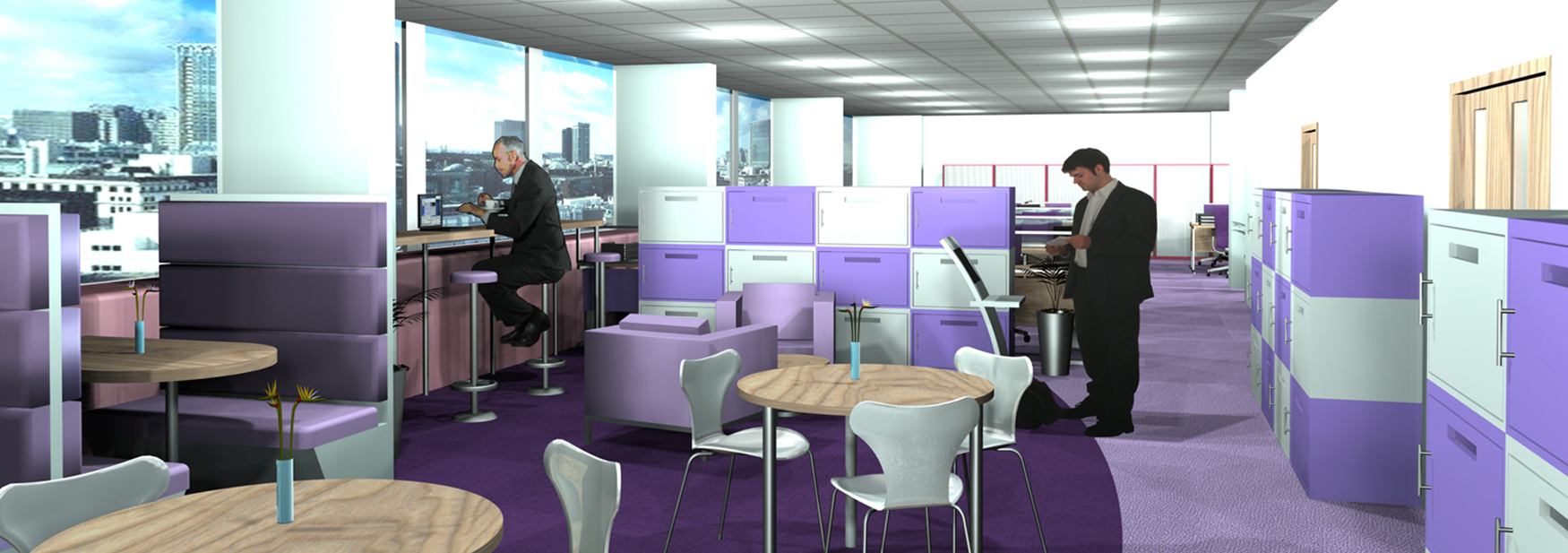
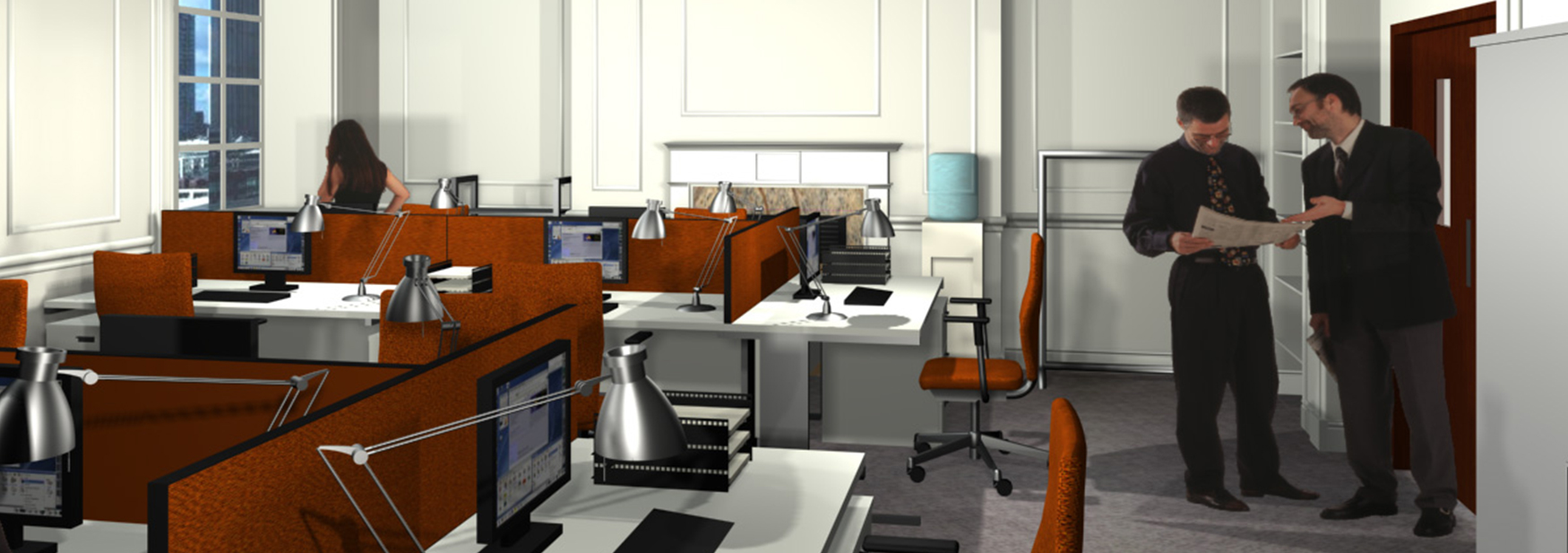
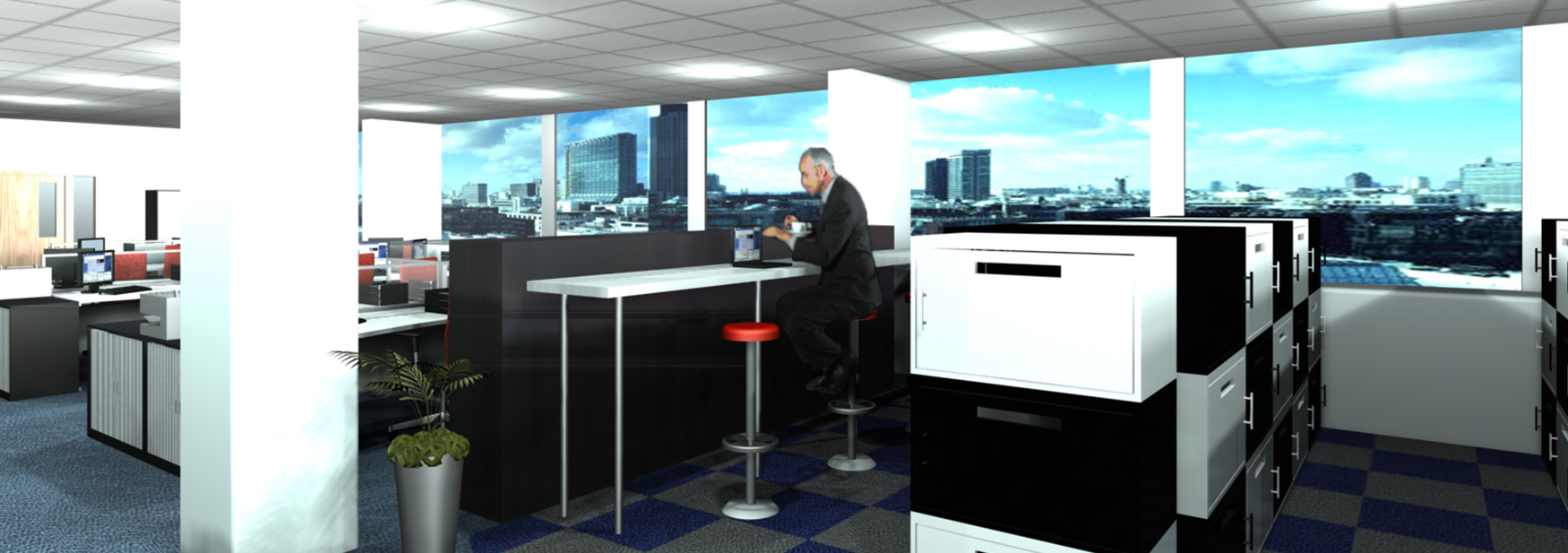
As well as producing 2d space plans, we also carry out 3d design services, but what exactly does this involve and what are the benefits? Put simply a 2d plan shows how a re-designed office would look as viewed from above; this is essential so that you know what will fit in, and that are you providing for all the required walkways and circulation routes. However the 2d plan is a view of the office that you will never actually get to see, and so this is the main benefit of using 3d design services in office design and space planning, which give you a realistic eye level view. Once we have an agreed 2d space plan, we are able to use this information, along with measurements and photos taken on site, to produce a 3d CAD model. We can then show this model as a series of views both at eye level and from above to show you exactly what your project will look like when completed. We can even show how it would look with different colour schemes and materials and also try out various different options such as open plan versus a layout with some cellular offices. In addition to this we can even produce a video walkthrough, which is a very realistic animated video taking a walk straight through your proposed office design. If you would to see some samples of this, try our gallery page, or drop us a line and we can email you some samples.
One of the most common questions we get asked is what size of area should be allowed per person in an office. The answer depends on many factors such as the size and type of office furniture, the office space available, and even the actual job roles being carried out. However in the UK there is a volume requirement for 11 cubic metres of space per person. There is a restriction on this saying that any ceiling height above 3m is not counted, as otherwise the actual area per person could be very small, but very tall, but going on an average ceiling height the overall office area per person should be at least 4.2 square metres. This may sound fairly generous, but the figure includes all useable space within the office and so also needs to cover all circulation walkways, fire routes, furniture and storage, so in reality unless you have very tiny desks you are generally unlikely to get down to this figure. The best way to work out the area per person however is to space plan the office ensuring that the layout covers all required fire routes, DDA (Disability Discrimination Act), and Health & Safety requirements, and usually after the office has been planned taking these in to account the average office tends to have about 7 square metres per person.
If you would like us to carry out an office space audit and show you exactly where you have wasted space, and how to improve your office design, drop us a line to discuss your requirements.
There are many companies that can recommend and supply office furniture, so what makes us different. Well, we are a fully independent space planning company, which means that we are not tied to any supplier or product range, and therefore we only recommend the products that will suit you best, rather than what would suit us best. This means that you get unbiased advice and we can suggest furniture companies that will supply you with the best office furniture for your needs. Every office is different and not all will need top-end expensive furniture, and we are able to give you details for companies that specialise in simple effective furniture, as well as companies that have very solid, hardwearing furniture that is designed to stand up to many office moves. We can even advise on furniture recycling and disposal if you are considering a total revamp. Additionally we are able to carry out furniture condition surveys, these are accurate colour coded plans that show your existing layout and the state of each office desk, office chair and item of storage. This can be particularly useful for larger companies that have a large amount of furniture and know that some of it is past its best, but other parts are perfectly serviceable. We would test each chair, each drawer etc, and then rate each item of furniture as to whether it should be replaced, or is in good working order.The plans are then marked up with coloured hatching so it is very simple to see exactly what is where and its condition.
If you would like our advice about your office furniture, give us a call to discuss.
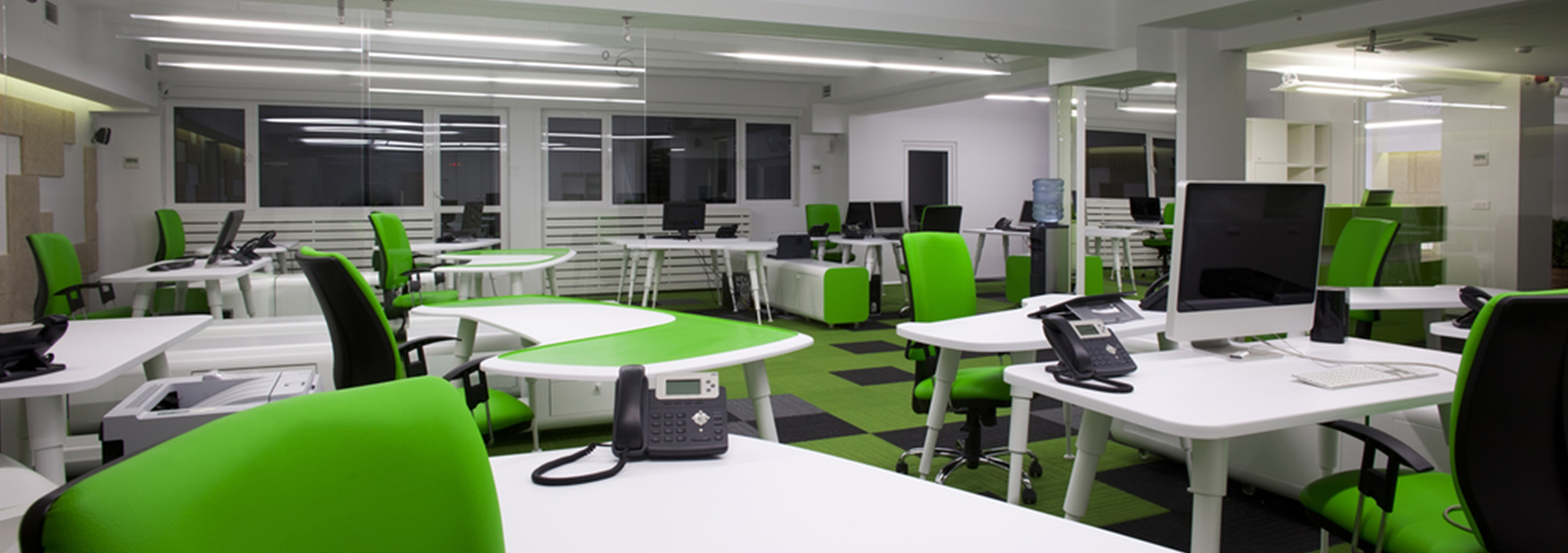
The size and shape of the office desk plays a major part in the final office design. Obviously, the larger the desk, the fewer you can fit in, but also the shape can play a big role is the layout too. The most common office desk type in the UK is still the “L-shaped” desk, also known as a corner (or sometimes crescent) desk. This desk type has a deep corner section, which is designed to house a large CRT monitor. However, the majority of monitors are now flat screens, and so this space is in effect redundant. The large return of the L-shaped desk means that you need to space them further apart in order to allow for adequate access between desks. This is especially important due to the DDA regulations (Disability Discrimination Act), which state that the office should be planned in such a way that it is useable by wheelchair users and the less able bodied. It therefore makes sense when planning an office layout to consider the type of office desk and go for something that allows for adequate surface space, but doesn’t require a huge amount of space between desks. A solution here would be a wave type desk, which has a slightly deeper end at one side, which is usually 200mm deeper than the rest of the desk top (compared with 800mm deeper for most L-shaped desks). In fact due to the ever shrinking size of desktop PCs, many companies are even going for rectangular (straight) desks, or even flexible bench type desking. These can further help to improve your office design by being very space efficient, whilst still useable. There are many other types of office desks available too, such as the double wave, the 120 degree desk, and the call centre pod, so if you would like advice as to what would work best in your office, just give us a call, or drop us an email (see contact page for details).
When preparing for an office move there are many factors that often get overlooked. The first, and probably most important one is the office design. Often there is an assumption that just because the new office is larger, the will be no problem in fitting in the furniture, but there are many factors that can complicate the layout of office furniture, and often make spaces less useable than they should be. Important things to look out for include- is there a raised floor (as this allows more flexibility in the office layout design); are there pillars / power poles; is the floorplate an unusual shape; is the new office layout open plan, or made up of cellular offices? By starting with a furniture survey we can make sure that your furniture will fit in to your new office, but also we can ensure that it is laid out in the most efficient way. Our space planning service can also include 3d visuals and interior design, and we can even help to future proof your office, planning the layout to allow for potential expansion at a later date. This way our office design service can save you money in the future, and ensure that your staff are happy now. Give us a call to discuss how we can help- 0845 166 8381.
We are often asked how can we help to make offices a little less cold and sterile, and a great way to do this is to maximise your natural daylight resources. The colour, feeling and effects of natural daylight just can’t be replicated by artificial light, and yet so many offices have poor layouts that block daylight within the office. A key principal here is to ensure that windows are not blocked by storage cabinets; the simplest way to do this is by putting all storage cabinets against partition walls. Most offices though have more storage cabinets than wall space, so the best way to ensure that natural daylight is maximised is to only ever have cabinets lined up perpendicular (at 90 degrees) to any windows. This may seem obvious, but so many offices have a row of tall cabinets running through the centre of the office space, and so these are actually parallel to the windows. What this then means is that one half of the office gets good natural daylight in the morning, but very poor in the afternoon and the other side vice versa. Through keeping the cabinets at 90 degrees some light is obscured, but you avoid the dark and light extremes. Of course investing in better storage solutions would help further, particularly a system such as a rolling stack (as discussed in earlier blog posts), as this would allow you to keep your storage in one area and so keep the open areas open.
As well as re-organising your storage, you should also look at the positioning of desks. A common mistake is to put a single manager’s desk (which is often unoccupied) next to the windows, with the bulk of the staff deeper in to the office floor plate away from the natural light. By ensuring that the natural light resource is maximised to as many workstations as possible, the overall feeling of the space for the staff will be improved. There are occasions, such as with a very large floor plate, when this can’t be done, and so here you may need to look as specialised lighting solutions, such as daylight simulation bulbs for individual desk lamps, and using as many transparent or translucent materials as possible around the office, such as frosted glass screens on desks rather than heavy fabric ones.
If you would like us to redesign your office to maximise your natural daylight resources, give us a call.
The one thing that we see time and time again when surveying offices is that most companies claim to be lacking in storage, yet the actual cabinets are often half empty. Effective office storage systems are absolutely critical to an effective office design layout, and the process needs to begin with an assessment of what actually needs to be stored on site. These days there are many office storage companies that offer archiving services that can allow you to store paperwork away from your office, yet be able to retrieve it quickly for a small fee. This can allow you to remove cumbersome storage cabinets from your office space and then open up the space improving both natural light and air circulation. There will always be some things that need to be stored on site, but with effective scanning systems every piece of paperwork can be catalogued and stored on your company servers. Not only will this reduce the need for office storage, but it also usually aids searching and retrieval as the scanned documents can be tagged with a wealth of information. There is also the added benefit that more than one person at a time can have a piece of information open, aiding information sharing, which is much more difficult when the information is held within a single paper folder.
It’s not just filing that takes up office storage though, as we often see large stationery store rooms. However these too are no longer as necessary as most stationery suppliers offer a next day delivery service, meaning that it is not so critical to maintain a large store on site. Even printed material can often be ordered via the internet on a much quicker turnaround than it used to be, meaning less space is required for its storage on site.
Call us to discuss your storage problems and see how we can help improve your overall design layout.
At the start of each project we carry out we survey your existing space and furniture to produce an accurate CAD plan. Whilst this is essential for accurate space planning, it can also be used for many other purposes. The way a CAD plan works is by having a series of layers of information that can be switched on and off at any time, and this means that you can have a single file with a wealth of information stored upon it. For example, there are a number of companies that we maintain the building and furniture CAD plans for, and amongst these we have information such as team names and areas of office space occupied. This allows us to show exactly which team is located where, how much space they take up, and the square meterage per person for that department. On another layer we then have the actual staff names and telephone extensions; particularly useful for HR purposes and also to give to new starters to help them get to know their colleagues, where they sit and what they do. On a further layer we even have IT information showing whether the desk has a desktop PC or a laptop, if there is a printer, if it is networked etc.
As you can see there is a lot more to a CAD plan than just the furniture layout, and if you would like us to produce and maintain plans of your office, drop us a line!